

Storing your pressure washer frost-proof before the first frosty night
Daniel von Detailing1 |


Koch-Chemie × COLOURLOCK
COLOURLOCK "Soft Slip" Top Coat additive for a velvety surface
Improve haptics for a velvety-soft leather surface
Koch-Chemie × COLOURLOCK
COLOURLOCK "Duller" matting additive for professional use
Matting additive for naturally matte repair results
Koch-Chemie × COLOURLOCK
COLOURLOCK "Leather Fresh Set XL"
1-Liter Polyurethane Tint F034 Black for Six to Ten Vehicles
Koch-Chemie × COLOURLOCK
COLOURLOCK "Leather Fresh C & P Set"
Cleaning, color refreshment and UV protection for smooth leather
Koch-Chemie × COLOURLOCK
COLOURLOCK "Blocker" barrier coat against bleed-through discolouration
Barrier coating against discoloration on leather

New: COLOURLOCK "Leather Cleaning Brush" lifts dirt out of the leather grain.
Koch-Chemie × COLOURLOCK
COLOURLOCK "Plastic Primer ND" primer for plastics
Perfect base for paint application with adhesion primer for plastic
Koch-Chemie × COLOURLOCK
COLOURLOCK "Care & Waterproofing Oil" nourishing oil and waterproofing for smooth leather
Care and waterproofing for open-pore leather


Koch-Chemie × COLOURLOCK
COLOURLOCK "Nubuck Eraser Block" Cleaning Eraser for Suede

Koch-Chemie × COLOURLOCK
COLOURLOCK "Complete Leather Repair Kit"
Complete Leather Repair Kit with Liquid Leather and Dye
Koch-Chemie × COLOURLOCK
Leather detergent with colour fixative for machine washing at 35 °C
Koch-Chemie × COLOURLOCK
COLOURLOCK "Nubuck Fresh" (Neutral) neutral colour-refresher base for nubuck and open-pore leather
Color-neutral refresher for nubuck and suede
Koch-Chemie × COLOURLOCK
COLOURLOCK "Thickener" additive for thickening coloured filler
Thickening Additive for Precise Filler Repairs
What is COLOURLOCK? The leather brand of Lederzentrum GmbH, specialised in nothing but leather since 1995 and today part of Koch-Chemie. The range covers cleaning, care, sealing, colouring and repair — including original leather colours by car brand, mixed to your own shade.
COLOURLOCK is the brand of Lederzentrum GmbH from Rosdorf near Göttingen — founded in 1995, under the Koch-Chemie roof in Unna since 2023. Where car care generalists clean leather and rub cream into it, COLOURLOCK covers the whole route: from foam cleaning through liquid leather for cracks to the leather colour that gets mixed to the original shade of your car. Trimmers, detailers and furniture makers work with the same system you buy here as an end customer.

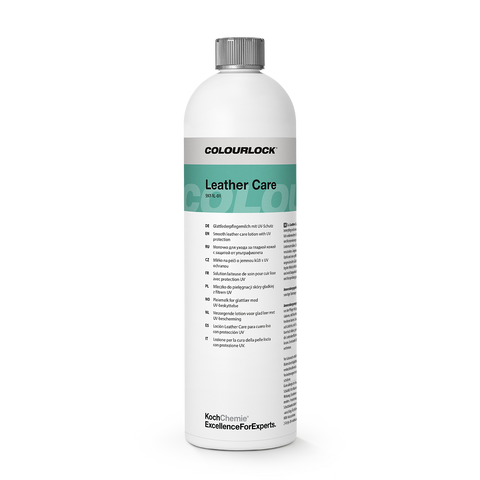
Day-to-day from Detailing1: The most common mistake on car leather isn't too little care, it's too much. Lay care milk on thick and the leather can't take it up — the emulsifiers dry as white streaks and leave a tacky film that pulls dust in. A hazelnut-sized blob of COLOURLOCK "Leather Care" does half a seat cushion, and two to four times a year is plenty. And keep silicone-based dashboard spray away from leather: silicone settles into the pores and still blocks the adhesion of any colour repair years later.
Lederzentrum GmbH set up in 1995 in Rosdorf near Göttingen as a specialist business for leather problems — COLOURLOCK is the brand that grew out of that repair work, one formula at a time.
That origin explains how deep the range goes. When you have hardened classic-car seats, denim dye transfer and worn-through bolsters on the table every day, you end up developing different products than a marketing department does: a re-fatting agent for brittle leather, a barrier coat against discolouration bleeding through, a cross-linker that makes repair colour abrasion-proof. Over the years that turned into the standard trimmers, detailing businesses and upholstered furniture makers right across Europe work with — up to the OEM quality car makers demand for their series leather.
In 2023 the founders sold Lederzentrum to Koch-Chemie GmbH in Unna. For you that mainly changes availability: COLOURLOCK now runs through the dealer network of one of the biggest German makers of vehicle care chemistry, while the product logic and the formulas stay the leather specialist's. Koch-Chemie covers the wash chemistry and paint work, COLOURLOCK the interior leather — two specialists under one roof instead of one generalist who half-does both.
For your buying decision that means: COLOURLOCK is the bridge between car care and the trimmer's trade. Everything short of a full retrim — clean, condition, protect, colour, repair — the system covers on its own.
If you want to get to know COLOURLOCK, you need four names first: the cleaner "Leather Cleaner", the care milk "Leather Care", the wear protection "Leather Shield" and the colour refresh "Leather Fresh".
The COLOURLOCK "Leather Cleaner" (Mild) is the routine clean for normally soiled smooth leather; the Strong version takes over once the driver's seat has that greasy shine. That shine, by the way, isn't a state of care — it's body grease rubbed in that has polished the matt grain smooth. You use the cleaner as a stiff foam, worked seam to seam with a soft leather brush — the foam holds the water at the surface instead of soaking stitching and padding. What that gets you: a thorough clean without swollen seats.
After that the route splits by the age of the leather. COLOURLOCK "Leather Care" is the care milk with UV protection for leather from about three years old — it puts back the fats that sun and heater air pull out of the material. New leather doesn't need those fats yet: here COLOURLOCK "Leather Shield" works as a pure wear barrier against friction and denim dye transfer. We regularly get messages about tacky, streaky seats — almost never a product fault, almost always too much conditioner on leather that's too young.
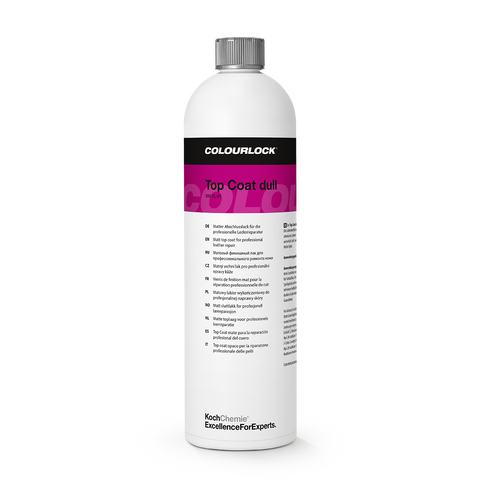
The fourth flagship, COLOURLOCK "Leather Fresh", is a water-based leather colour you dab on: it hides wear and faded patches in the original shade. Honest limit: on constant-rub zones like a steering wheel rim, any dabbed-on tint wears off again. If you want series durability there, you seal the colour the way the pros do with COLOURLOCK "Top Coat" plus cross-linker — that ties the colour molecules into one continuous net as it dries, like the clear coat over your paintwork. You notice it like this: the repaired spot survives denim seams and fingernails again.

We've sorted the COLOURLOCK range at Detailing1 into six bundles so you come in through your problem and not through an alphabetical product list.
It always starts with cleaning — from the mild smooth leather cleaner through the special cleaner for aniline and nap leather to stain removers for grease, superglue and stubborn discolouration. Right next to it sits care with the "Leather Care" milk, the aniline cream and the oils for hardened leather.
The third bundle, sealing & impregnation, protects sound leather against abrasion, moisture and dye transfer — from new-leather protection to synthetic leather sealing. Once it starts to show, you reach into the colouring & finish bundle: colour refreshers, solid leather colours, primers and the finish lacquers in several gloss levels.
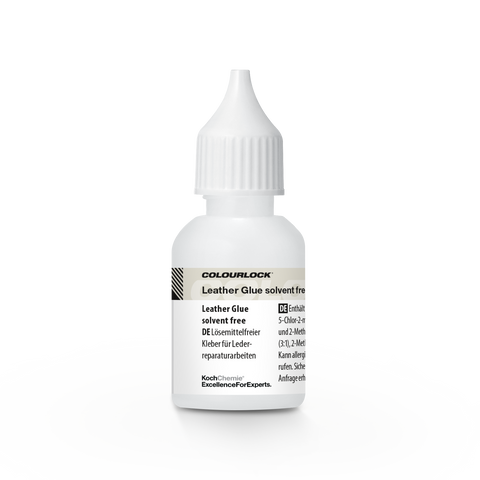
For damage to the substance there's repair — liquid leather, fillers, adhesives and pre-treatments. And if you don't want to combine things one by one, grab one of the sets: ready-made routines for new leather, used smooth leather, classic cars, steering wheels or sneakers. The rule of thumb: single problem, single product — whole seat or whole sofa, set. A side note on mixed trim: Alcantara is microfibre, not leather. For that, COLOURLOCK "Pol Star" sits in the cleaning bundle as a cleaner concentrate for fabric, leather and Alcantara that handles combination trim in one pass.
Clean, repair, colour, protect — that's the order every trimmer works in, and it's the order your project at the kitchen table comes off in too.
Before the first move comes the diagnosis, and it costs one drop of water: rub it in on an inconspicuous spot. If it beads up, you have pigmented smooth leather — the tough standard in nearly every car seat. If it soaks in and leaves a dark patch, you're sitting on open-pored aniline leather, which only tolerates mild products like COLOURLOCK "Aniline & Nubuck Cleaner". What that gets you: one drop of water decides which shelf you shop from — and saves you from gluing velvety nap leather up with care milk.
The second key term is the top coat: modern car leather leaves the factory with a wafer-thin, flexible colour and clear coat build — strictly speaking your seat is painted. Which is why most "leather damage" is really paint damage, and exactly why it can be repaired. The condition is a grease-free surface: before any colouring you degrease with the COLOURLOCK "Degreaser", and on old care layers you soften them as well with the COLOURLOCK "GLD Solvent" so the new colour finds a bridge to the old layer. From what we see: when a colour repair flakes off, it was almost never the colour — it was silicone and grease residue nobody removed.
Hardened leather needs a step before that: the COLOURLOCK "Old Leather Softener" soaks into the stuck-together fibres over several days and makes them supple again before any colour goes on at all. Plan the whole thing calmly: water-based colours and lacquers need roughly 24 hours to cross-link fully. The first time round that feels slow — it comes with the job, and it's the difference between a repair that holds and one that splits open the first time someone gets in.
That leaves the question of rhythm. The driver's seat is the main load zone and gets a gentle clean plus protection or conditioning every three months. The passenger seat and the rear bench get by on one pass every six to twelve months. More brings you nothing — leather has a limited take-up capacity, and everything above that sits on top as a film. If you run a finger over the panel after conditioning and it glides instead of grabbing, you dosed it right.

The biggest difference to any other leather brand in the range: you don't get some black or beige, you get the documented shade of your car.
Behind the COLOURLOCK original leather colours sits a shade database covering decades of series trim — from a nineties Mercedes shade to a current Porsche interior. At Detailing1 you'll find the split by car brand as its own overviews, for instance for Mercedes-Benz, BMW or Porsche. Every one of these colours is a mix-to-order item: it gets made up to your shade once you order, not pulled off a shelf.
Two routes lead to a hit. On younger cars the factory colour name from the vehicle data is enough, and the database translates it into the original recipe. On older leather the more honest reference is the leather itself — sun and wear shift every shade over the years. A sample of about 1 cm² from a hidden spot does it, say under the seat or off the underside of the headrest: the lab then mixes to the patina the hide has grown into instead of the new-car formula.
Honest limits come with it. Bright shades like red and yellow cover less by nature — the pros prime light underneath here instead of stacking coat on coat until the spot feels hard. And never pick a shade on a screen: monitors distort what you see. That shortcut is the most common reason self-picked colours land visibly off — which is why we push for a sample comparison on any aged leather rather than an order by eye.
If your leather is under three years old you need no fats and no polish — cleaner plus "Leather Shield" keeps the matt new-car state. From three years the "Leather Care" route takes over, and on a classic everything starts with the softener.
For the most common situations there's a curated way in: the COLOURLOCK "Smooth Leather Care" Set covers used smooth leather in the car and on the sofa, the steering wheel set rescues the worn constant-contact zone before a lease return, and the sneaker and shoe care carries the brand from the car seat into the hallway. Long-time users online agree that the same logic holds up: leather seats that still look almost new after several hundred thousand kilometres with colour-matched cleaning and care are no one-off in the community, they're the result that keeps coming back.
Trade detailers and trimmers use the same system one level up: cleaner in the big container, a colour build of primer, solid leather colour and finish lacquer out of the spray gun with the cross-linker mixed in. That's the route when a whole interior has to reach the abrasion resistance of series production — and the reason you'll find additives in the colouring & finish bundle that look like lab supplies at first glance. As a beginner you don't need them: leaving the spray system out keeps your first project simple, and for hiding wear in the original shade the dabbed-on version is plenty.
Just as clear in the other direction: cracks or open seams anywhere near airbags — the steering wheel centre, bolsters with a side airbag — are not a DIY repair but a job for a certified trimmer, because any change to the material can disturb how it deploys. The same goes once the foam is showing through: where substance is missing, any filler tears open again under the pull of someone sitting down. COLOURLOCK doesn't replace the trimmer — it makes the many cases before that manageable.
What we keep seeing at Detailing1: success or frustration rarely comes down to the product, almost always to the prep. Clean your leather before you condition it, and degrease it before you colour it — then COLOURLOCK behaves the way the leather specialist has been building it for the pros since 1995. And the one piece of advice no bottle carries: cut your colour sample out of the hidden spot before you need it. Once you have your leather's shade on record, you repair every future scratch in the original colour instead of a compromise.

Too much choice in COLOURLOCK × Koch-Chemie? Get help picking:
Add Detailing1 as a preferred source on Google
Daniel von Detailing1 |

Daniel von Detailing1 |

Daniel von Detailing1 |

Daniel von Detailing1 |

Daniel von Detailing1 |

Daniel von Detailing1 |

Daniel von Detailing1 |

Daniel von Detailing1 |

Daniel von Detailing1 |

Jasper von Detailing1 |

Daniel von Detailing1 |

Daniel von Detailing1 |