


What a car leather sealant protects and what it doesn't
Daniel von Detailing1 |


Koch-Chemie
Cleaning Clay "Rkr" Abrasive "Red" Clay Bar
Abrasive cleaning clay for heavily soiled paints


GYEON
Q²M Iron (REDEFINED) Iron Remover
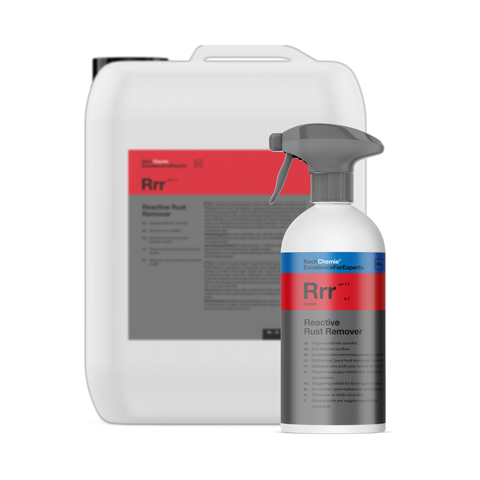
pH-neutral rust remover with gel formula and color indicator


INNOVACAR
Effective rust remover for rims and car body


GYEON
Q²M TotalRemover Wax and Coating Remover
Q²M TotalRemover - wax and coating remover before
What does paint preparation involve? Two steps before any polish. First the chemistry dissolves whatever has bonded into the clear coat, then the clay bar lifts whatever is still sitting on top. At Detailing1 you'll find clay in two grades, clay pads and the right lubricants.
Paint preparation is the step between the wash and the polish where the paint loses everything that has lodged itself in it. Chemically first: iron removers pull out embedded iron particles, tar removers the sticky bitumen spatter. Then mechanically: the clay bar lifts off whatever sticks up above the paint surface. At the end, the paint is smooth, bare and ready for polish and sealant.
Detailing1's tip from the shop: We often get questions about fine scratches that show up under raking light after the first time claying. There are almost always two causes: too little lube and reaching for the aggressive clay first. Start with the mild grade and only switch once the mild one stops picking anything up after two passes. Spray so generously that the clay glides on a standing wet film, and move it in straight lines, not circles. And plan the polish straight after, so it takes care of the last traces in one go.
Paint preparation isn't a single step but a fixed sequence of chemical and mechanical decontamination that sits between the wash and the polish.
Two groups of cleaners handle the chemical part. Rust remover products work with thioglycolate, an active ingredient with a free sulphur end that grabs every trivalent iron ion like a pair of pliers and pulls it into solution. You see it as a purple haze running off. For you, that means whatever was stuck firmly in the clear coat a moment ago you just rinse away, without touching it.
Tar removers come at it from the other side. Bitumen spatter and tree sap are organic and dissolve in aliphatic hydrocarbons, a bit like grease in washing-up liquid. After the dwell time, the spots run down in thin brown streaks. Every stage from pre-wash to specialist cleaner is under Paint cleaning.
Then comes the mechanical part. A clay bar is a soft polymer compound made of thermoplastic elastomers that you glide over the paint on a film of lube. Whatever sticks up out of the surface gets caught in the clay, the way chewing gum picks up grains of sand off the ground. The paint isn't cut down, it's cleared off.
Why this order and no other: every particle the chemistry has already dissolved doesn't end up in the clay. And every grain stuck in the clay travels across the paint on the next pass. Do it the other way round and you're working against yourself, burning through far more material for the same result.
What you end up with is paint that's smooth and carries no protection at all. That's exactly the state it should be in going under the machine or straight under the sealant. What comes next is under Polishing and in the wider Sealing and care section.
No other move in detailing gives you as much information in ten seconds as a thin plastic bag over your hand on dry paint.
The routine is simple. Wash the car, dry it, slip an ordinary freezer bag over your flat hand and run it over the bonnet without pressure. Take your rings off first. What you'll feel is a fine grit that's as different from smooth paint as woodchip wallpaper is from glass.
The physics behind it is friction. Your fingertips are soft and wrap around small bumps instead of catching on them. The thin plastic can't do that; it slides over the surface and snags briefly on every particle. In plain terms: the bag turns your hand into a measuring tool with finer resolution than your eye under raking light.
Where you'll find it first is the same on every car. Bonnet, front bumper and the lower half of the doors collect the most, because they take the headwind and the spray from the front wheels head-on. Roof and boot lid catch everything that comes from above, like rail dust and sparks from nearby industry.
We often see customers skip the test on light paint, because they can spot orange-brown dots there anyway. On black and dark blue it's the other way round: you feel the contamination long before you see it. That's exactly why touch is the more reliable check, not lighting.
After claying, you do the counter-check on the same spot. The bag has to glide over the surface as if you were running it over a window. If it still catches anywhere, that area needs another pass. That's the only success check you need in this category.
The category splits into soft clay, harder clay and flat pads, and the difference lies in aggressiveness and speed.
Mild clay is the default and the only thing you need on a regularly maintained car. The Koch-Chemie Koch-Chemie Reinigungsknete „Rkb" Mild „Blau" Clay Bar picks up iron fallout, bug remains and overspray without noticeably affecting the surface. It's our best-selling clay in this category and the right answer nine times out of ten.
The aggressive grade has finer abrasives in the compound and goes after what the mild one leaves behind: baked-on residue, old overspray layers, heavily contaminated used cars. The Koch-Chemie Cleaning Clay „Rkr" Abrasive „Red" Clay Bar leaves visible marring, fine dull haze under raking light. Only use it when a polish is already firmly on the plan.
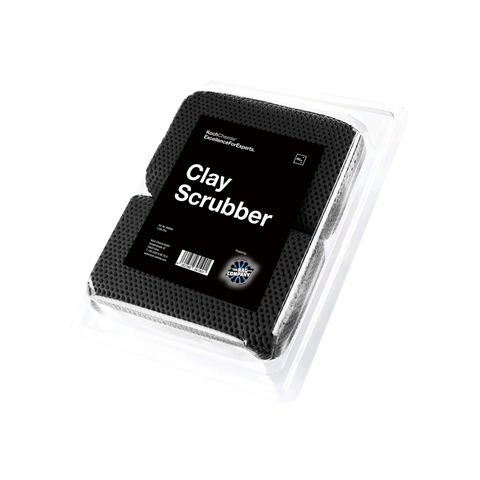
Pads and sponges solve a speed problem. The Koch-Chemie Clay Scrubber Sponge and the Koch-Chemie Clay Pad carry the polymer layer on a backing you hold in your hand and rinse off as you go. On an estate you'll save a good half of the time compared with a classic clay bar.
For the machine, the same idea comes as a disc. The SONAX PROFILINE ClayDisc „150" clay pad runs on the polisher's backing plate at low speed and works through large horizontal panels in a few minutes. On edges, body lines and tight curves, handwork is still the cleaner solution.
As a refill for a spent clay bar we stock the Meguiars SMOOTH SURFACE Clay Bar Replacement Detailing Clay. If you want to compare the full range with every grade and backing, you'll find it under Cleaning clay.
The lubricant isn't an accessory, it's the part of the system that decides whether you'll have to polish afterwards or not.
A clay lube is a water-based solution with surfactants and slip agents that lowers the water's surface tension and leaves a continuous film of lubrication. The clay floats on it instead of touching the clear coat. Tell-tale sign: the clay practically glides on by itself, and the drag drops noticeably as soon as the surface is clean.
The range has several ready-to-use sprays for this. The Koch-Chemie Clay Spray „Cls" Clay Lube for Decon Clay is the best seller in this category and our standard pick alongside the mild clay. The GYEON Q²M ClayLube (REDEFINED) Clay Bar Lubricant is the choice for ceramic-coated cars.
For a cheaper way in, go for the D-CON Clay-Lube Clay Bar Lubricant Spray or the INNOVACAR „DL" Lube Clay Bar Lubricant Spray. Both give you the same slip film, it just doesn't last as long, so you'll respray more often on large panels.
To be honest, there's a stopgap: shampoo water from the bucket works, it just breaks up faster and dries on warm paint in under a minute. For a single wing that's fine, for a whole car it becomes a source of mistakes. In our experience, most scratch complaints come from exactly this setup.
Two rules to finish that no product replaces. Clay works best between ten and twenty-five degrees; below that it gets hard and leaves marks, above it it smears onto the paint. And if it ever drops on the floor, it goes in the bin: a single grain of sand in it turns the clay into sandpaper. Pads and sponges, on the other hand, you can simply rinse off.
The reason for all this effort comes down to a simple hardness comparison between an embedded iron particle and the abrasive in your polish.
A particle of brake dust is harder than any abrasive in the polish. If it gets under the spinning pad, it turns into a cutter and drags a fine trail right across the panel. What you then see under raking light isn't a polishing mistake but skipped decontamination. Two hours of work then hinge on five minutes that were missing beforehand.
The same applies before sealing, for a different reason. A ceramic or spray sealant closes off the surface and preserves every particle still sitting in it. The rust spot keeps working under the protective layer, and you can't get at it for twelve months without taking the layer back off.
Expect an in-between stage that feels wrong. After claying, dark paint often looks duller under raking light than before, because the clay leaves fine marring. That's part of the process and disappears completely with the first polishing pass. On soft Japanese paint it's more noticeable than on hard German paint.
Just as important is what the paint has lost after claying: every layer of wax, every spray sealant, every last bit of protection. A clayed panel is bare clear coat. Without a new protective layer it'll pick up more over the next few weeks than before, which is why at least a spray sealant goes on the same day.
For frequency, a simple rhythm has proven itself: once or twice a year, plus any time a polish or a new sealant is due. More often isn't needed, because every pass costs a little clear coat. If you park next to railway tracks or a building site, lean towards the shorter gap.
The choice comes down to three questions: how contaminated is the paint, how big is the surface, and does the car already have a sealant on it.
For your first setup, one clay bar and the matching lube are enough. The Koch-Chemie Koch-Chemie Reinigungsknete „Rkb" Mild „Blau" Clay Bar together with the Koch-Chemie Clay Spray „Cls" Clay Lube for Decon Clay covers a normally used car completely. The first time it'll take you around ninety minutes, by the third time it's forty.
If you look after several cars or have an estate with a lot of metal in front of you, switching to a backed pad pays off. The Koch-Chemie Clay Pad and the Koch-Chemie Clay Scrubber Sponge can be rinsed off as you go and last far more cars than a clay bar you've eventually folded through.
If your paint has a ceramic coating, stick with the mild clay and add the GYEON Q²M ClayLube (REDEFINED) Clay Bar Lubricant. Still, expect to take the layer off and renew it afterwards. Clay can't tell the difference between contamination and coating.
If you're claying for the first time and would rather have everything in one box, grab the Meguiars HYBRID CERAMIC Synthetic Clay Kit Clay Bar. Clay, lube and towel are matched to each other, and there's no mixing to get wrong. For the second round, you just buy the clay again.
And if your bag test barely shows any roughness: skip the step. Paint that feels smooth doesn't need clay, just the chemical round with Rust remover and then straight on to Polishing or fresh protection from the Sealing and care section. Work you don't need is the most expensive part of any detail.
Too much choice in Paint preparation? Get help picking:
Daniel von Detailing1 |

Daniel von Detailing1 |

Jasper von Detailing1 |

Daniel von Detailing1 |

Daniel von Detailing1 |

Daniel von Detailing1 |

Jasper von Detailing1 |

Jasper von Detailing1 |

Daniel von Detailing1 |

Daniel von Detailing1 |

Daniel von Detailing1 |

Daniel von Detailing1 |