



Stop water spots before you have to polish them out
One question lands in our inbox again and again — not “how do I get the spots off,” but “does this product stop water spots in the first place?” It’s a fair worry, because this week Nordhorn gets exactly the weather that turns a harmless drop into a permanent ring: a dry, clear run-up, then rain at up to 31°C. Learn how a spot forms now and you save yourself the polishing later.
Water spots are nothing more than dried-in minerals. Pull the water off quickly after a wash or a shower, keep hard water away and seal the paint so it stays hydrophobic, and you head off most rings before they start. And if a spot does show up, the right chemistry beats scrubbing every time.
This week brings exactly the weather that makes spots
A dry, clear spell is about to give way to rain and a heat peak of up to 31°C, and that combination is the classic trigger for water and lime spots on paint. Together the two are far more dangerous than either one on its own.
Rain after a long dry stretch is rarely clean water. It grabs dust, pollen and industrial particles out of the air and lays them down as a fine film on the bodywork. Once that film dries, you’re left with more than minerals — you get a lightly abrasive layer of grime. That’s exactly why a car often looks dirtier after the first summer shower than it did before, even though it just got wet.
The heat makes the window brutally short. On sun-warmed metal a drop flashes off in minutes instead of half an hour. The faster the water goes, the more concentrated the mineral residue left behind — and the sooner it burns itself in. The current humidity of 86% does stretch the drying time in the shade, but the moment the sun hits the paint, it flips the other way.
Wash your car this week, or leave it out unprotected in the rain, and you’re working against the clock. That’s not scaremongering, it’s simply why we say prevention beats cure in this kind of weather. Ten minutes of drying today is half an hour of polishing come autumn.
Why a single drop leaves a ring
A water drop is never pure water. As it dries, the dissolved minerals stay behind as a white ring, and in the heat that ring etches into the clear coat instead of just sitting on top. A spot you could have wiped away turns into a pit you have to polish out.
The culprit is water hardness. Tap water carries calcium and magnesium compounds, measured in German degrees of hardness. Those salts stay behind when the water evaporates and form the classic lime ring with the pale halo around the edge. Translated: the harder your water, the more visible the ring — and the less it forgives a quick bake-on in the sun.
It gets critical when the mineral ring sits on hot paint long enough. The clear coat swells ever so slightly in the warmth, and the concentrated mineral layer presses into that open structure. You can tell the difference: a fresh spot wipes off, an old one stays as a dull circle even after a wash. That’s the line between cleaning and correcting, and it’s decided in the first few hours.
This is where one water spot parts ways with another. On glass and plastic the ring usually just sits on the surface and comes off. On freshly washed, warm clear coat, though, it can set in over a few days. That’s why we treat a bonnet that baked in the sun all day differently from a side window in the shade.
How hard your water is comes down in your supplier’s drinking-water report, given in German degrees of hardness. Anything over 14 °dH counts as hard, and across large parts of Germany the tap water sits right in that band. In practice: where the water is hard, a single dried drop already leaves a visible ring, while soft water dries off almost residue-free. That’s no side note — it’s the reason the same drying job shows rings on one car and not on another.

Drying right away is half the protection
Pull the water off quickly with a soft drying towel after a wash or a shower and you rob the minerals of their drying window — nothing’s left on the paint to evaporate in the sun. Drying isn’t a side step, then; it’s the real spot prevention.
A high-pile drying towel like the Koch-Chemie Pro Drying Towel 950GSM soaks the water up instead of pushing it around. The number 950 GSM stands for grams per square metre — the density of the pile. In practice: a denser towel takes up more water in one pass, you wipe less, and less wiping means less risk of fine scratches. Lay the towel flat and drag it across the panel rather than rubbing.
Better still if the water never lies there as a film in the first place. On a clean, sealed surface the sheet of water breaks up and runs off in wide bands — sheeting, as it’s called. What runs off can’t dry in. That’s why the order wash, pull off, check beats the shampoo itself in this weather.
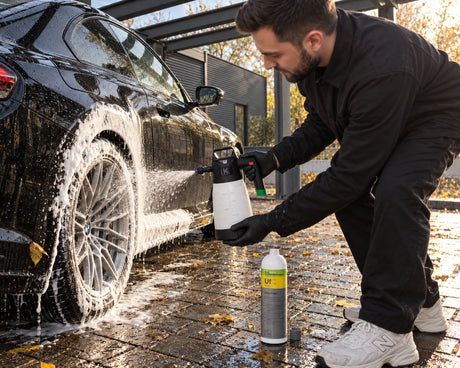
And then there’s water quality. For the last pass over glass and chrome, soft or de-limed water pays off, because it brings barely any minerals with it. No access to that? Just work faster: wheels first, then wash panel by panel and dry each one straight away — never foam the whole car and leave it standing in the sun. A low-contact pre-wash with Koch-Chemie Gentle Snow Foam „Gsf“ keeps the coarse grit off your towel.
The reason for this strict order is simple: a dried-on area can’t be pulled off any more, only treated afterwards. So wash panel by panel and dry each one at once instead of foaming the whole car in one go. For low-contact washing the two-bucket method helps — you rinse the wash mitt in a second bucket before it goes back on the paint. That way you don’t carry the loosened grit back onto the wet surface, where it would otherwise dry in as the next ring.
When the spot is already there
Fresh water spots come off with a quick detailer and a microfibre cloth, but baked-in lime rings need an acidic component that dissolves the mineral film chemically instead of just shoving it around. The difference between the two is the difference between wiping and cleaning.
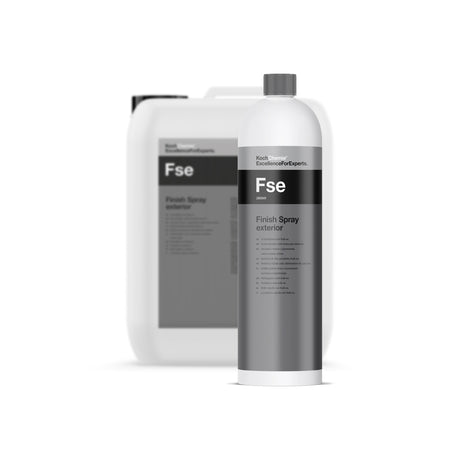
For the fresh case a spray detailer like the Koch-Chemie Quick & Shine „Qs“ does the job: spray on, lift off with the cloth, done. But once the ring has set, plain wiping only moves the lime around, because it’s missing the chemical counter-force. This is where the Koch-Chemie Finish Spray Exterior „Fse“ goes to work with its Kalk-EX formula at pH 2.5. The acidic value neutralises the basic lime compounds in a straight acid-base reaction, like a chemical counterpart to the mineral. For you that means: the ring releases without you scrubbing under pressure.
The way you use it follows a firm rule, because otherwise the acid works against you. The car belongs in the shade, the surface has to be cool and dry, or the product flashes off too fast on hot metal. If the panel still feels hand-warm, wait five minutes. Then two or three pulls per panel, don’t over-spray a big area, and give it 30 to 60 seconds of dwell time on stubborn spots before you lift it off with a soft microfibre cloth in circular motions. More on removal alone is in our piece Removing water spots from your car.
Let’s be honest about the limit: the Fse is an acidic cleaner and not meant for cars with an active ceramic coating or fresh wax protection, because the acid can attack the protective film. If you’re looking after a coating, go at mineral rings more gently and skip the acid hammer. For everyone else the Fse dissolves lime, water spots and mineral residue on paint, glass and plastic in one step, and its polymer wax even leaves a light protective film behind. You’ll find an overview of all spray detailers in the Quick Detailers category.

The home-remedy trap and other mistakes
Vinegar and citric acid do dissolve lime, but they attack coating and wax and act completely uncontrolled — and even more often, two utterly ordinary moves ruin the paint: rubbing it dry and letting it air-dry in the sun. Both turn a cosmetic problem into real damage.
The home-remedy reflex is understandable — kitchen acid is cheap and it’s everywhere. The problem is the lack of control: you know neither the concentration nor the dwell time, and on a sealed or waxed surface the acid eats away exactly the protection you actually wanted to keep. A proper product with a defined pH 2.5 isn’t marketing, it’s simply the difference between a predictable result and a random one.
The second mistake comes from convenience. Letting the car drip dry in the sun saves you two minutes and costs you the whole job, because that’s precisely when the minerals you just rinsed off dry back in. And go at a dry, set-in spot with a dry cloth and you drag the hard mineral particles across the clear coat, picking up fine scratches that show as swirls in raking light.
The third, quiet mistake is over-dosing. More doesn’t help here — quite the opposite: spray the detailer over a big area and you get streaks and a longer buff-off. Two or three targeted pulls per panel give a better result than a soaking-wet surface. Less product, more control, and less work in the end.
Next time it just beads off
A hydrophobic spray sealant lowers the surface tension far enough that water runs off as big, round beads instead of lying there as a flat film — and less contact area simply means less mineral ring. Prevention beats removal here, because the spot never forms in the first place.
The active bit behind it is a thin silicon-oxygen layer, a mesh of silicon and oxygen that lays itself over the paint like a smooth, water-repellent skin. On that skin the water pulls itself into beads — the familiar beading — and runs off by itself as you drive or in the next shower. You can tell by this: after sealing, the car needs a full wash noticeably less often, because the dirt barely clings any more.
You put it on with the Koch-Chemie Spray Sealant „S0.02“ straight after the wash, onto the still-damp or freshly pulled-off surface — spray a thin coat and level it out. The staying power of a spray sealant like this runs realistically from a few weeks to a couple of months, depending on your wash interval and how hard the car works, and you can top it up with every wash. Want it even leaner? Reach for the Fse, whose polymer wax leaves a light protective film with every use. All the options are in the spray sealants category.
A sealant pays off double in summer, because it doesn’t just bead water off — it also makes pollen, tree sap and insect residue cling less well. What doesn’t stick doesn’t have to be removed, and what beads off leaves no ring. So the same move guards against several summer problems at once, instead of needing a separate product for each. Once you’re in the rhythm, top the sealant up every second wash and keep the effect going for good, without much extra work.
Prevention comes down to your head, too, in the end. A car that dries in the shade after rain instead of in blazing sun barely collects rings. Know that rain and heat are coming, and you seal beforehand and pull the water off quickly afterwards, rather than polishing later. We took apart exactly how summer rain behaves on paint in our piece Does rain wash your car.

Detailing1 insight: From our day-to-day, the best trick against lime rings comes right at the end of the wash: pull the last pass over glass and chrome with a separate towel and soft or de-limed water, not the tap water from the hose. Exactly where the hard water sits last is where the most stubborn rings form. One customer had dull circles on his rear window for weeks even though he dried meticulously, and we pinned it on one thing: he always rinsed off with the garden hose. Two litres of soft water for the final pass fixed it.
No time for the whole post? Get it summarized:
Add Detailing1 as a preferred source on Google